
Navanethem “Navi” Pillay Wins 2026 Nobel Peace Prize
October 9, 2026
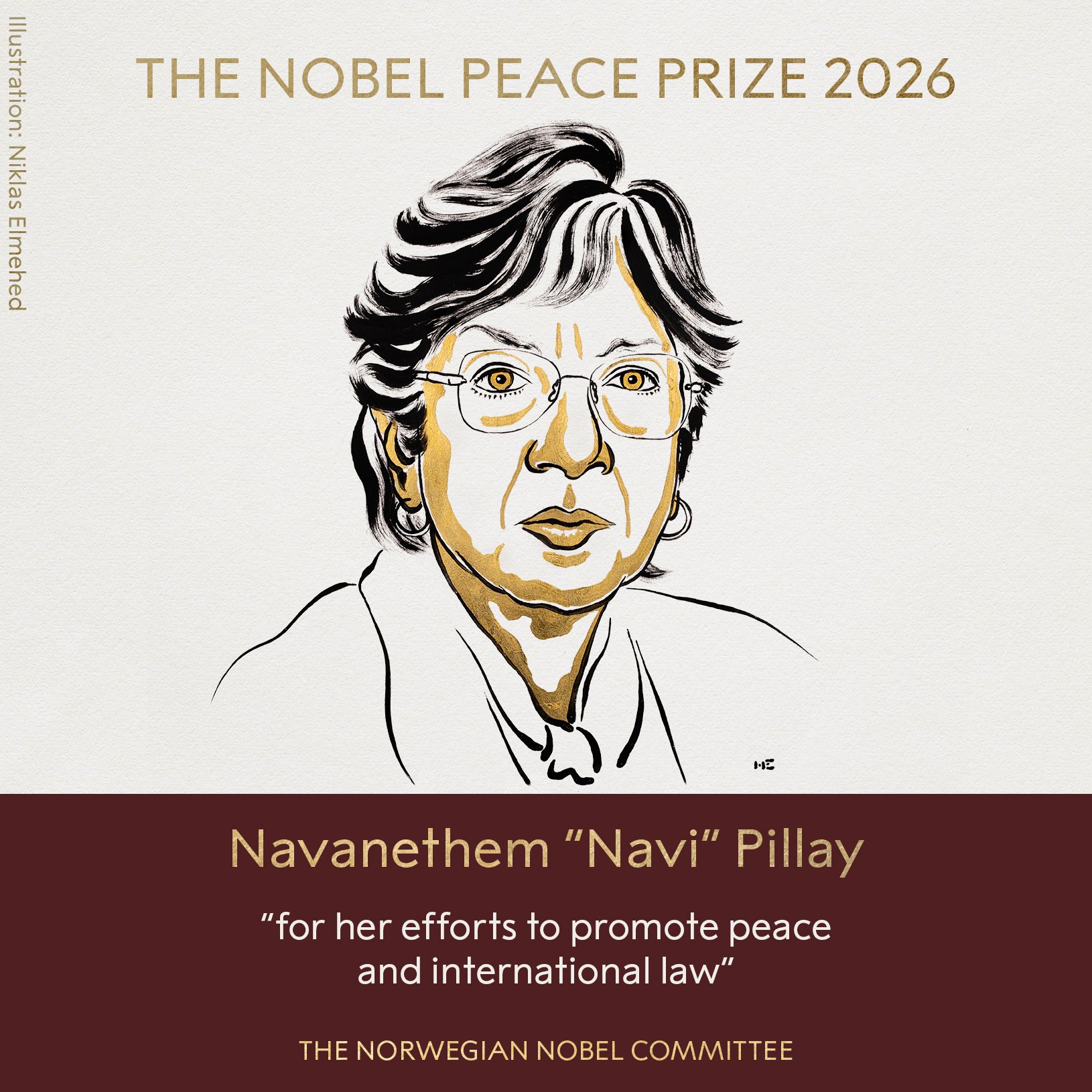
Illustrator Niklas Elmehed © Nobel Prize Outreach
This morning, the Norwegian Nobel Committee announced Navanethem “Navi” Pillay as the 2026 winner of the Nobel Peace Prize.
“It's not an act of nature that leaves more than one billion people around the world locked in the jaws of poverty. It's a result of the denial of their fundamental human right to development. We must act together to make the right to development a reality for everyone.” –Navi Pillay
Born into apartheid in Durban, Natal Province, South Africa in 1941, Ms. Pillay started a law practice in Natal at age 26, the first woman ever to do so. She later earned her Doctor of Jurisprudence (JD) from Harvard Law School, the first South African to earn this degree.
She began defending anti-apartheid activists, including Nelson Mandela and other political prisoners housed on Robben Island who had not been given access to legal counsel, and later co-founded Equality Now, an international women’s rights group. After the end of apartheid, Ms. Pillay was appointed to the High Court of South Africa, the first non-white woman ever to serve on the court. Shortly thereafter, she was appointed to the International Criminal Tribunal for Rwanda, serving for eight years (four as president), a highlight of which established rape and sexual assault as an international war crime, a form of genocide, and a crime against humanity. The tribunal also brought to light the role of disinformation and propaganda in inciting genocide.
Ms. Pillay was one of the first judges to serve on the International Criminal Court in The Hague, Netherlands, which hears cases of war crimes, genocide, and crimes against humanity. For six years, from 2008 to 2014, Ms. Pillay then served as UN High Commissioner for Human Rights, which she described as “the voice of the victim everywhere.” She currently sits on the International Court of Justice.
“Racism and xenophobia have created chasms in societies,” said Ms. Pillay in 2012, “and oftentimes provide, propel, and perpetuate narratives that propagate and sustain conflict. Racism and intolerance are often at the root of conflict and, frequently, the human rights violations that take place during conflict are a manifestation of racial and ethnic discriminatory policies and practices.
“I know first-hand as a former international judge how the dissemination of hate messages lead to massacres, brutality, systematic rape and sexual violence, and eventually genocide, as was the case in Rwanda. Racism and prejudice have been used as powerful weapons to engender fear or hatred of others in times of conflict or war, and have been used as tools to mobilize one group against the other during conflict or in order to provoke conflict.
“Racism and intolerance continue to cause conflicts and undermine peace and security. Like every human rights issue, racism throws up the critical protection needs of those affected by it, and those most vulnerable to it.”
Speaking on behalf of the committee, Chair Jørgen Watne Frydnes explained the committee’s choice: “In awarding this year's Nobel Peace Prize, the Norwegian Nobel Committee wants to remind the world that the rule of law—national and international—underpins the system we have set up to ensure peace and resolve conflicts non-violently.
“Peace requires justice. History has shown that the world operating without the rule of law is unjust, unwise, and inhumane. The judges, those who guard the thin red line between order and chaos, are, therefore, highly deserving of our praise. But today, as these same judges are sanctioned and their institutions are under attack, we need people of courage, vision and determination, qualities that Navi Pillay demonstrates in her work on the bench.
“Navi Pillai's commitment to justice and human dignity is a source of hope,” Frydnes continued. “An inspiration to all those who seek to bring about a more peaceful world.
Following the announcement, when asked why the committee had chosen this year to highlight international courts that have been in existence for decades, Fryndes responded, “The institutions that uphold international law are under tremendous pressure, sanctions and attack. In the world we are living in with more conflicts than in a long time, supporting, strengthening and also expanding the work of these institutions are key to a more peaceful world. That is why it's important, this year, in particular. Brutal regimes and politicians in the world, they don't respect international law, nor their institutions.”
This year’s prize joins a distinguished list of Peace Prizes that the Committee has previously awarded, in fulfillment of Alfred Nobel’s will, which recognizes efforts of “the greatest benefit to humankind.” JA Worldwide salutes the international-justice work of Navi Pillay, as well as the other 286 candidates for this year’s prize. Seventy-nine of those nominees were organizations, including JA Worldwide.